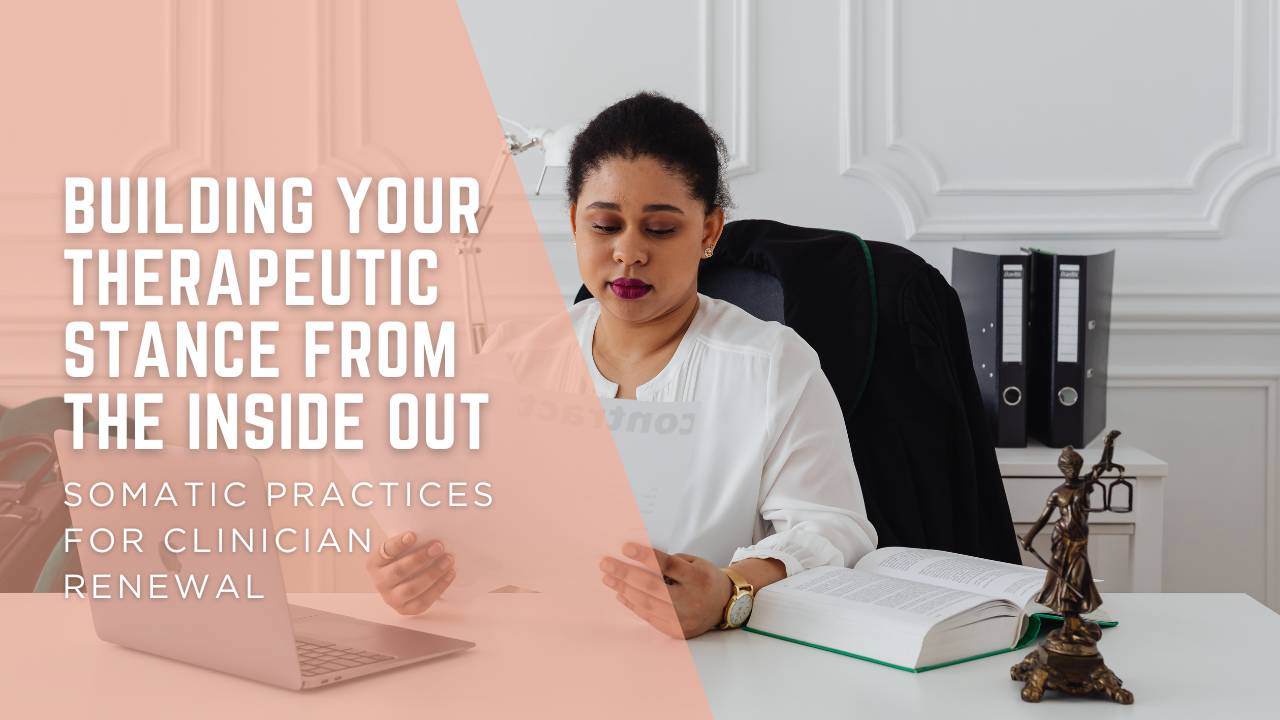
Confidence Isn't a Technique: Building Your Therapeutic Stance from the Inside Out
If you've ever watched a skilled couples therapist hold the room during an escalation - staying calm, centered, and directive while two people are flooded with emotion - you might have thought: I could never do that.
Here's the thing: that therapist probably thought the same thing at some point.
The directive presence required for couples work isn't a technique you learn from a manual. It's something you build from the inside out - by attending to your own relationship with authority, leadership, and discomfort.
The Confidence Clients Can Feel
Research consistently shows that clients notice when their clinician is confident - and when they're not. Studies on therapeutic alliance have found that clinician anxiety and self-doubt can negatively impact client perceptions of the relationship, while therapists who appear confident, calm, and trustworthy create environments where clients feel safe enough to do difficult work (Murray et al., 2018).
In family therapy research, both adolescents and parents describe valuing therapists who are "well-regulated, calm and safe," who have "integrity as an adult and a professional," and who maintain a "calming, composed and fair stance" - especially during moments of conflict (Lavik et al., 2018; Gilson & Abela, 2021).
This isn't about performing confidence. Clients can tell the difference. It's about cultivating a genuine sense of groundedness that allows you to hold the room.
Genuineness Can't Be Faked
Blanco, Muro, and Stickley (2014) define genuineness as "being real, using your honest self within the counseling relationship" and being "free from insincere behavior." They emphasize that therapists must be "fully present, self-aware, and confident" in their abilities for genuineness to emerge - and that this quality strengthens the therapeutic relationship.
In couples work, the stakes are even higher. You're not just building a relationship with one person - you're holding a space where two people can risk vulnerability with each other. That requires a therapist who isn't performing neutrality or faking calm, but who actually has access to an internal steadiness.
The problem is that most of us weren't explicitly trained for this. We learned techniques. We learned theories. But the development of the therapist's internal capacity - our relationship with our own authority, our comfort with leading, our ability to tolerate tension - often gets addressed only indirectly, if at all.
The Identity Work Underneath
Watkins (2012), writing about therapist development, points out that "becoming a psychotherapist is very much about becoming able to effectively use one's self during the treatment process." He describes how beginning therapists often struggle with feelings of inadequacy - and how gaining "some self-perception of competence and confidence" is acquired through repeated exposure to vulnerabilities and learning to tolerate the discomfort that comes with that exposure.
This means that building confidence isn't about avoiding the situations that make you uncomfortable. It's about moving toward them - carefully, with support - and discovering that you can tolerate more than you thought.
For many clinicians, couples work is exactly the kind of situation that exposes these edges. The intensity is higher. The demand for leadership is more explicit. And there's nowhere to hide when both partners are looking at you, waiting for direction.
From External to Internal
Ray and colleagues (2020), studying counselor development, identified a theme they called "externalized to internalized expectations." Early in training, therapists often rely on external structures - what they're supposed to say, how they're supposed to act, what the "right" intervention is. Over time, with practice and reflection, these expectations become internalized. The therapist moves from following rules to trusting themselves.
This shift is what allows genuine confidence to emerge. It's the difference between thinking "I need to appear confident" and actually being confident because you've done the internal work to trust your own judgment.
In couples work, this shows up as the ability to be directive without being rigid. To hold a frame without being controlling. To lead the session while staying responsive to what's actually happening in the room.
What Gets in the Way
If confidence were easy, every clinician would have it. So what gets in the way?
Often, it's our own unexamined relationship with authority. Many of us became therapists in part because we value collaboration, mutuality, and non-hierarchical relationships. The idea of being "the authority in the room" can feel uncomfortable - even antithetical to our values.
But couples work requires a different stance. Couples in distress often need someone who can interrupt destructive patterns, set a structure, and hold boundaries around the conversation. This isn't about being authoritarian - it's about being authoritative. And for many clinicians, that distinction requires some internal excavation.
There's also the matter of our own discomfort with conflict. If we grew up in families where conflict was dangerous, chaotic, or suppressed, we may have an automatic response to de-escalate tension at all costs - even when staying in the tension would be more therapeutic.
Building from the Inside Out
So how do you build the kind of confidence that can't be faked?
Start with awareness. Notice your internal responses when you imagine leading a couples session. What comes up? Anxiety? Excitement? Dread? Curiosity about your own reactions is the first step.
Examine your relationship with authority. What messages did you receive growing up about leadership, power, and being in charge? How do those messages show up in your clinical work?
Practice tolerating discomfort. Confidence isn't the absence of discomfort - it's the capacity to stay present with discomfort without being destabilized by it. This can be practiced in small doses, both in and out of session.
Seek supervision and consultation. The development of therapeutic presence benefits enormously from relational support. Find supervisors and colleagues who can help you see your blind spots and grow your edges.
Be patient with yourself. This is developmental work. Watkins (2012) reminds us that struggling with confidence is "normative, requisite, and a sign of personal and professional progress." You're not behind - you're in process.
Felicia Romano, MA will be leading a training on Foundations of Couples Work: Tools for Clinicians on March 18th, addressing how to build genuine confidence as a directive presence in couples therapy. [Register here - early bird pricing through March 1st.]
References
Blanco, P. J., Muro, J. H., & Stickley, V. K. (2014). Understanding the concept of genuineness in play therapy: Implications for the supervision and teaching of beginning play therapists. International Journal of Play Therapy, 23(1), 44-54.
Gilson, M. L., & Abela, A. (2021). The therapeutic alliance with parents and their children working through a relational trauma in the family. Contemporary Family Therapy, 43, 120-132.
Lavik, K. O., Veseth, M., Frøysa, H., et al. (2018). 'Nobody else can lead your life': What adolescents need from psychotherapists in change processes. Counselling and Psychotherapy Research, 18(3), 262-273.
Murray, R., Baker, A., Halpin, S., et al. (2018). Therapeutic alliance between dietitians and patients with head and neck cancer: The effect of training in a health behavior change intervention. Annals of Behavioral Medicine, 52(12), 1057-1066.
Ray, D. C., Lankford, C. T., Malacara, A. B., et al. (2020). Exploring counselor experiences of training in relational depth: An interpretative phenomenological inquiry. Journal of Counseling & Development, 98(2), 157-168.
Watkins, C. E. (2012). On demoralization, therapist identity development, and persuasion and healing in psychotherapy supervision. Journal of Psychotherapy Integration, 22(3), 187-205.