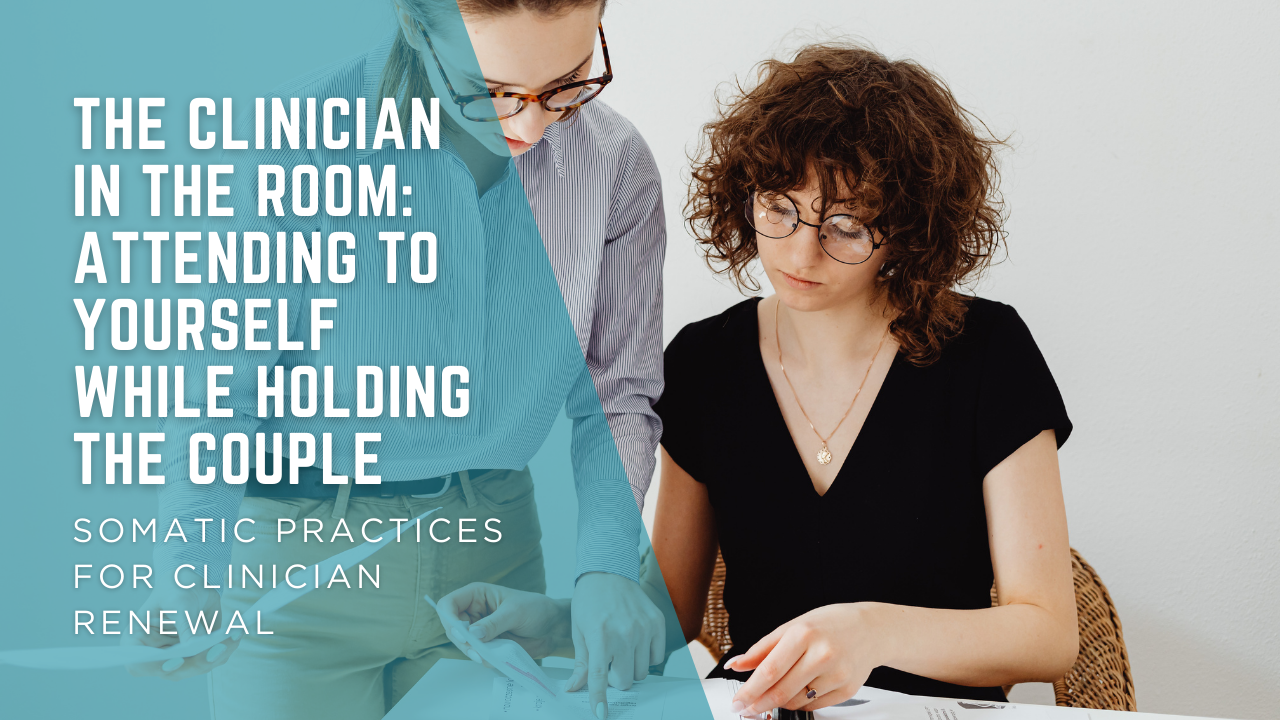
The Clinician in the Room: Attending to Yourself While Holding the Couple
There's a moment in couples work - maybe you've felt it - when something shifts inside you before you're even aware of what's happening. One partner says something cutting, the other shuts down, and suddenly you notice your jaw is tight, your breathing has changed, or you're mentally rehearsing what you want to say next instead of listening.
This is the clinician in the room. And learning to attend to yourself - without losing your clinical footing - is one of the most important skills in relational work.
Triggered vs. Informed: A Critical Distinction
Not every internal reaction is a problem. In fact, some of our most useful clinical data comes from what we notice in our own bodies and minds during session.
Back and Arnold (2006) put it simply: "Notice and use your own emotional reactions as a diagnostic and therapeutic tool." The goal isn't to eliminate our responses - it's to develop the capacity to observe them without being hijacked by them.
There's a difference between being triggered and being informed by your reactions:
Triggered looks like: Over-identifying with one partner. Feeling urgent need to intervene. Mentally taking sides. Losing your center. Avoiding certain topics because they make you uncomfortable.
Informed looks like: Noticing a tightness in your chest when one partner dismisses the other - and getting curious about what's happening in the dynamic. Registering your own irritation and asking yourself what it might be mirroring in the relationship. Using your felt sense as data about what's unspoken in the room.
The Practice of Non-Judgmental Observation
Wiggins (2009) describes mindfulness as "detached, non-judging observation or witnessing of thoughts, perceptions, sensations, and emotions" - a way of self-monitoring that allows us to stay aware without getting swept away.
In couples work, this might look like:
- Noticing you're leaning toward one partner and gently recentering
- Catching yourself planning your next intervention instead of staying present
- Recognizing that your frustration with a client's pattern mirrors something from your own history
- Feeling the pull to rescue and choosing not to act on it
This isn't about being a blank slate. It's about developing what Aponte and Winter (1987) called awareness of "person-of-the-therapist issues" - the personal history, worldview, and relational patterns we bring into every session.
When You Feel In Over Your Head
Here's something we don't talk about enough: sometimes you'll feel like you're in way over your head. Hook and colleagues (2025) describe a therapist working with a complex case who reflected, "I was definitely running up against a limit."
This feeling isn't failure - it's information. It might be telling you that you need more training, more consultation, or that something in this particular case is touching your own unprocessed material.
The work isn't to never feel overwhelmed. The work is to notice when you're approaching your edge and respond wisely - whether that means seeking supervision, slowing down in session, or simply naming to yourself what's happening.
Staying Present Without Losing Yourself
Zoellner and colleagues (2011), writing about therapist training, identified a common challenge: finding "the appropriate level of therapist involvement in session." Too distant, and we lose attunement. Too involved, and we lose perspective.
In couples work, this balance is especially tricky because the emotional intensity can be high and both partners are watching for signs of whose side we're on.
The answer isn't detachment - it's grounded presence. The capacity to be with strong emotion without being destabilized by it. To hold both partners' experiences without collapsing into either one.
This capacity develops over time, through practice and self-reflection. It's not something you either have or don't have - it's something you cultivate.
Your Reactions Are Part of the Work
The next time you notice yourself activated in a couples session, try this: instead of pushing the feeling away or acting on it immediately, get curious. What just happened in the room? What might this reaction be telling you about the dynamic between these two people? What might it be telling you about yourself?
Your internal experience isn't separate from the clinical work. It is part of the work.
Felicia Romano, MA will be leading a training on Foundations of Couples Work: Tools for Clinicians on March 18th, addressing the therapeutic stance required for effective couples work - including how to stay grounded while holding the intensity of the room. [Register here - early bird pricing through March 1st.]
References
Back, A. L., & Arnold, R. M. (2006). Taking your communication skills to the next level. AMA Journal of Ethics, 8(9), 595-598.
Hook, J. N., Davis, D., Owen, J., et al. (2025). Working within your limits. In Cultural Humility in Therapy. American Psychological Association.
Wiggins, M. I. (2009). Therapist self-awareness of spirituality. In J. D. Aten & M. M. Leach (Eds.), Spirituality and the Therapeutic Process. American Psychological Association.
Zoellner, L. A., Feeny, N. C., Bittinger, J. N., et al. (2011). Teaching trauma-focused exposure therapy for PTSD: Critical clinical lessons for novice exposure therapists. Psychological Trauma: Theory, Research, Practice, and Policy, 3(3), 300-308.