
The Crisis Text You Dread (And Why Your Body Won't Let You Rest After)
It's 9 PM on a Sunday.
You've just sat down. Finally. The first moment of quiet all weekend.
Your phone buzzes.
Your stomach drops before you even look.
It's a client. "I need help. I don't think I can make it through tonight."
You respond. You assess. You create a safety plan. You stay on until you're sure they're stable. You do everything right.
It's now 11 PM. The crisis is contained. Your client is safe.
But you can't sleep. Your heart is racing. Your mind is running through everything that could still go wrong. You're checking your phone every few minutes. Your body is wired.
This is what we don't talk about enough: the nervous system cost of holding life-and-death stakes.
The Holiday Amplification
This time of year, these texts multiply.
Clients struggling with family gatherings that trigger old trauma. Grief intensifying around empty chairs at holiday tables. Financial stress compounding. Isolation deepening while everyone else seems surrounded by joy.
Your caseload becomes a minefield of risk. You're constantly assessing, constantly vigilant, constantly braced for the next crisis.
And then well-meaning people tell you to "take care of yourself during the holidays" and you want to scream: How? When people's lives are on the line?
The Hypervigilance Trap
Here's what happens to clinicians who work with high-acuity clients, especially during the holidays:
Your nervous system learns that vigilance equals safety.
Every time you catch a warning sign, every time you intervene successfully, every time your alertness prevents something terrible—your brain gets reinforced: "See? This hypervigilance is keeping people alive."
So scanning becomes your baseline. Your body stays in a constant state of activation. Even when there's no active crisis, you're ready for one.
The problem? What once protected your clients is now destroying you.
You can't sleep. You can't be present with your own family. You pick up your phone compulsively. You feel your chest tighten every time you see a client's name. The activation never fully discharges—it just accumulates.
"But My Clients Are Actually Suicidal"
I know what you're thinking: "This isn't just anxiety. My clients ARE in crisis. I can't just 'relax' when someone's life might be at stake."
And you're absolutely right.
Appropriate clinical concern is not the same as chronic hyperactivation.
There's a difference between being responsive to real risk and living in a constant state of alarm 24/7—even when you're off the clock, even when everyone is safe, even when there's no active crisis.
Here's what happens when we conflate clinical responsibility with constant activation:
We lose our discernment. When everything feels like an emergency, we can't accurately assess what actually is one. Our window of tolerance narrows, and we become less effective at the very thing we're trying to do—keep people safe.
We burn out. And then we're no good to anyone—not our clients, not our families, not ourselves.
Hypervigilance feels like it's protecting your clients. But it's actually just slowly destroying you—and making you a less capable clinician in the process.
What Your Body Needs After Crisis
When you respond to a client in crisis—whether it's a late-night text, a session where someone reveals suicidal ideation, or holding someone through a panic attack—your nervous system mobilizes.
This is appropriate. This is your biology doing exactly what it's supposed to do to help you respond effectively.
The problem is: we never discharge that activation.
Animals in the wild shake, tremor, and move after escaping danger. They complete the stress response cycle. Their nervous system returns to baseline.
Humans? We check our email. We move to the next session. We go make dinner. We push through.
The activation stays in our bodies. Session after session. Crisis after crisis. Week after week. Especially during the holidays when the crises intensify and the opportunities for discharge disappear.
This is why you can't sleep after crisis texts. Why you're checking your phone constantly. Why your body won't let you rest even when everyone is currently safe.
Your nervous system is still running the program: "Stay alert. Someone needs you."
December 17th: Experience Rest While Learning About It
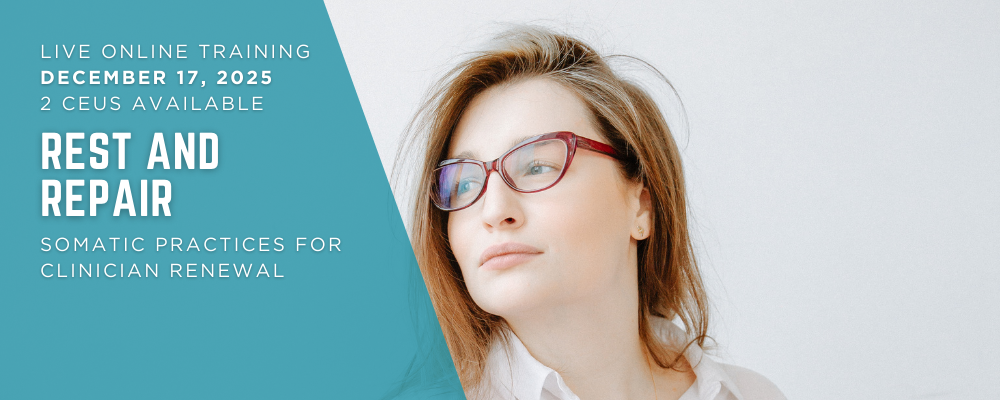
I'm offering a training through the Somatic Integration Institute specifically for clinicians who work with high-acuity clients, who hold life-and-death stakes, who can't just "unplug" because people's safety is genuinely at risk.
Rest & Repair: Reconnect. Regulate. Restore.
Tuesday, December 17th, 1-3 PM EST
But here's what makes this different: This isn't just didactic learning. This is experiential.
For two hours, you get to be in community with other clinicians who hold what you hold. You'll practice regulation together. You'll give your nervous system actual rest—not just information about rest.
This isn't about meditation apps or bubble baths. This is about nervous system regulation for clinicians who can't afford to be unreachable.
You'll Experience:
- Two hours that restore rather than deplete you
- Virtual community with clinicians who understand the weight of crisis work
- Guided practices that help your nervous system discharge activation in real-time
- Space to actually slow down instead of just pushing through
This isn't another demanding training that leaves you more exhausted. You'll leave feeling more regulated than when you arrived.
You'll Learn:
- The difference between clinical vigilance and chronic hyperactivation (and how to have one without the other)
- How to discharge activation after crisis responses—in 60-90 seconds
- Why your body won't let you rest (and how to work with that, not against it)
- Tools to help your nervous system return to baseline between crises
- How to assess: "Do I need better self-care or do I need to change my work?"
You'll Practice:
- Orienting and grounding (for overwhelm and activation)
- Pendulation (to discharge stuck stress)
- Self-soothing and containment (when you can't turn it off)
You'll Leave With:
- A personal somatic renewal plan that works for YOUR life and YOUR caseload
- 2 CEUs for counselors and social workers
- The training recording to return to when you need it
- Tools you can actually use in the 30 seconds between sessions
Cost: $15
Financial assistance available—email [email protected]. I mean it. If cost is a barrier, reach out.
Group discounts available—bring your colleagues. You don't have to do this alone.
You Can't Pour From an Empty Cup (But You've Been Trying)
The holidays will end. The crisis texts won't.
You can keep running on adrenaline and hypervigilance. You can keep checking your phone at 2 AM. You can keep sacrificing your nervous system for your clients' safety.
Or you can learn how to discharge the activation. How to return to baseline. How to hold high-stakes work without destroying yourself in the process.
Your clients need you regulated, not martyred.
And you—you deserve to sleep through the night. To be present with your own family. To not feel your chest tighten every time your phone buzzes.
That's what we're practicing on December 17th.
Register Here - Rest & Repair Training
Because holding life-and-death stakes is hard enough. You shouldn't have to do it while running on empty.
Rest & Repair: Reconnect. Regulate. Restore.
Offered by the Somatic Integration Institute
Tuesday, December 17th, 1-3 PM EST
Live Virtual Training | 2 CEUs | Recording Provided
$15 | Financial assistance available
Group discounts available
Questions? Email [email protected]
P.S. If you're reading this at 11 PM after a crisis text, unable to sleep—this training is for you. You're not broken. Your nervous system is doing exactly what it was trained to do. We're going to help it learn something different. And you won't be alone—you'll be with others who get it.